Overview
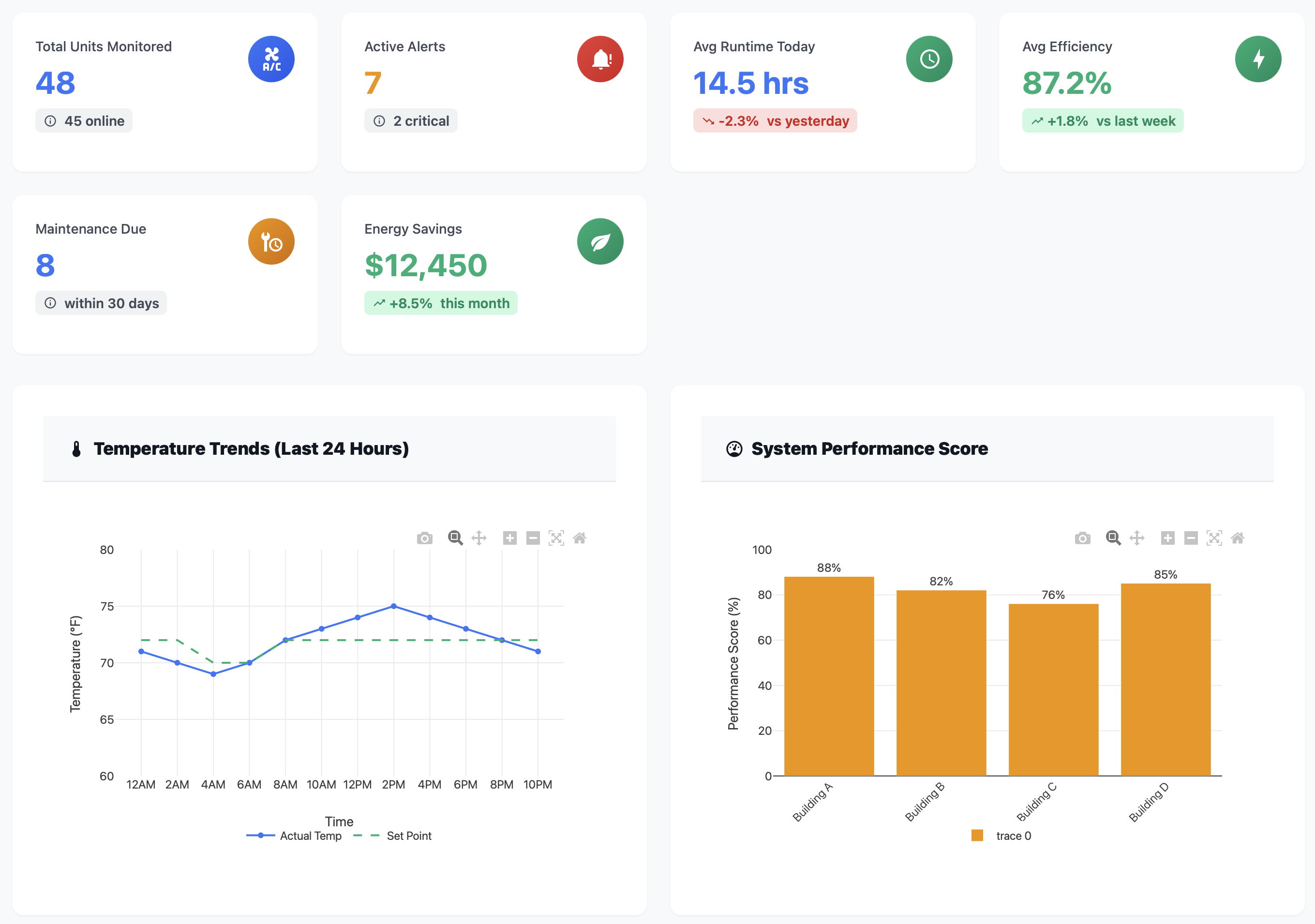
Track temperature, runtime, efficiency, and performance across all HVAC equipment from a single dashboard. Know instantly when something's wrong.
Full Content
Track temperature, runtime, efficiency, and performance across all HVAC equipment from a single dashboard. Know instantly when something’s wrong.
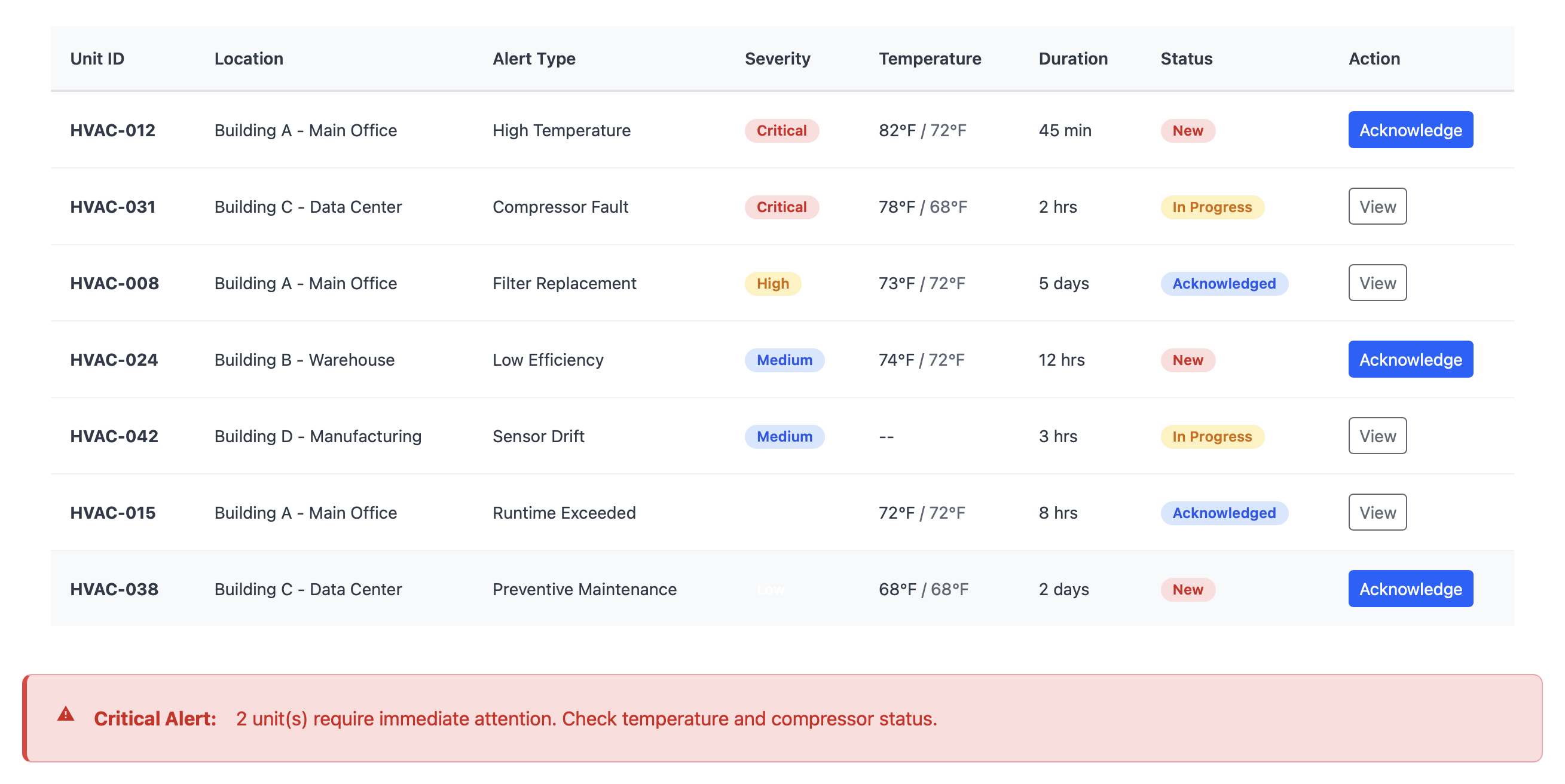
IoT sensors detect anomalies early. Get alerts for compressor faults, sensor drift, and efficiency drops—before your customer calls you.
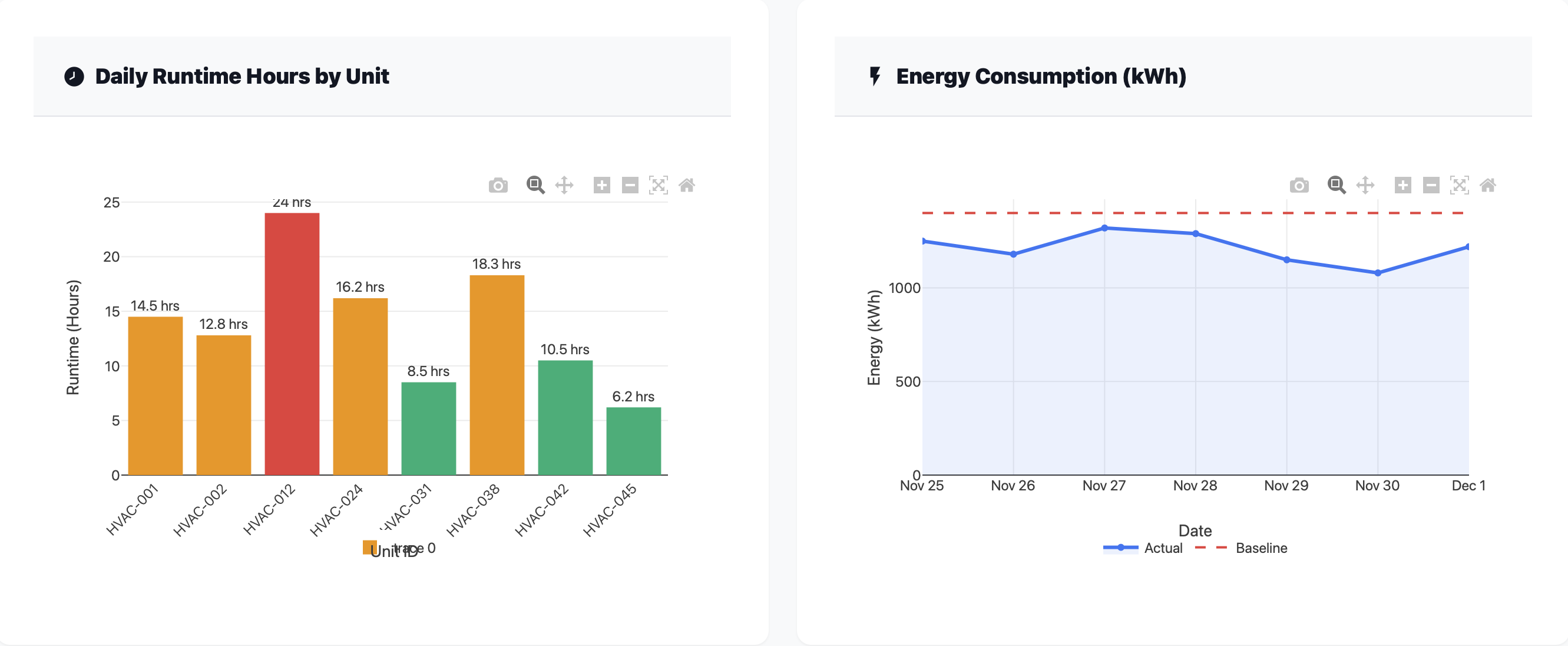
Identify underperforming units dragging down efficiency. Optimize runtime, reduce energy waste, and extend equipment lifespan.
The HVAC Service Problem Costing You Customers
HVAC service companies lose money and reputation every day to preventable failures. Common issues include:
Reactive service calls: You only know about problems when customers complain
No fleet visibility: Hundreds of units across locations with no central monitoring
Missed maintenance windows: Equipment fails because PM schedules slip
Energy waste undetected: Inefficient units run for months without notice
Alarm fatigue: Too many alerts, not enough actionable intelligence
Slow response times: Critical failures escalate while you’re unaware
💸 Average cost of an emergency HVAC failure: 3, 500–8,000+ including equipment damage, overtime labor, and lost customer trust.
From Reactive Calls to Proactive Service
Monitor and compare HVAC performance across every location.
Location |
Avg Efficiency |
Units at Risk |
|---|---|---|
Building A |
88% |
2 |
Building B |
82% |
4 ⚠️ |
Building C |
91% |
0 ✅ |
See every unit’s status at a glance.
Temperature vs. set point deviation alerts
Runtime hours trending high → compressor stress
Efficiency <75% → immediate inspection needed
Unit HVAC-012 flagged: 82°F vs 72°F target
Emergency calls: 45/month
Avg response time: 4.2 hours
Customer complaints: 28/month
Equipment failures: 12/month
Emergency calls: 18/month (–60%)
Response time: 1.1 hours (–74%)
Complaints: 8/month (–71%)
Failures: 3/month (–75%)
The ROI of Proactive HVAC Management
Scenario |
Annual Service Costs |
Customer Retention |
|---|---|---|
Reactive Only |
$850K |
72% |
IoT + Preventive |
$620K |
89% |
IoT + Predictive AI |
$540K |
94% |
Features That Transform HVAC Service Operations
Track actual vs. set point temperatures across all units. Instant alerts when deviations exceed thresholds.
Monitor daily runtime hours per unit. Identify overworked equipment before compressor failure occurs.
Real-time efficiency ratings for every unit. Spot degradation trends and schedule service before performance tanks.
Severity-based alerts (Critical, High, Medium, Low). Acknowledge, assign, and resolve—all from one screen.
AI-powered failure prediction based on sensor data, runtime patterns, and maintenance history. Schedule service at the right time.
Measure energy consumption vs. baseline. Prove ROI to customers and identify units wasting kilowatts.
Who Benefits Most
Dispatch techs proactively, reduce emergency calls, and keep SLAs on track with real-time fleet visibility.
Manage hundreds of units across multiple sites. Identify systemic issues and optimize technician routes.
Ensure occupant comfort, reduce energy bills, and get ahead of equipment failures that disrupt operations.
Real-World Results
A commercial HVAC service company managed 480 units across 12 buildings with no centralized monitoring. Emergency calls averaged 52/month. Average response time exceeded 4 hours. Customer satisfaction: 68%.
After 6 months of IoT monitoring: ✅ Emergency calls ↓ 65% ✅ Response time ↓ 74% (4.2 hrs → 1.1 hrs) ✅ Equipment failures ↓ 75% ✅ Energy savings: $127K/year ✅ Customer satisfaction: 94% ✅ Contract renewals: +22%
“We used to wait for the phone to ring. Now we call customers before they know there’s a problem.” — Operations Director, Regional HVAC Service Company
Your HVAC Command Center
Seamless Integration with Your Stack
Getting Started
1️⃣ Connect Your Sensors → Integrate existing IoT infrastructure or deploy new sensors.
2️⃣ Configure Locations → Map units to buildings, floors, and zones.
3️⃣ Set Alert Thresholds → Temperature, efficiency, runtime limits per unit type.
4️⃣ Import Maintenance History → Enable predictive scoring with historical data.
5️⃣ Train Your Team → 30-minute onboarding for dispatch and techs.
6️⃣ Monitor & Optimize → Watch efficiency climb and emergency calls drop.
Frequently Asked Questions
Q: Do I need new IoT hardware? Not necessarily. We integrate with most major HVAC IoT platforms. If needed, we recommend cost-effective sensor solutions starting at $50/unit.
Q: How are failure predictions generated? By analyzing temperature patterns, runtime hours, efficiency trends, and maintenance history against thousands of failure signatures.
Q: Can I set different alert thresholds per building? Yes—customize temperature ranges, efficiency minimums, and runtime limits for each location or unit type.
Q: Does it work with both commercial and industrial HVAC? Absolutely. Rooftop units, split systems, chillers, VRF systems, and data center cooling are all supported.
Q: Can my technicians access it in the field? Yes, the dashboard is fully mobile-responsive. Techs can acknowledge alerts, view unit history, and update status from any device.
Q: How quickly will I see ROI? Most companies see measurable reduction in emergency calls within 30–60 days. Full ROI typically within 4–6 months.